This image is a map of the world's deposits of rare earth minerals.
China’s September 2010 spat with Japan regarding waters which both countries claim as part of their exclusive sovereign territory amounts to another feud in a series of Chinese border conflicts. What differentiates this dispute from the others was China’s willingness to halt the export of rare-earth minerals to Japan in order to gain advantage in the altercation. This behavior reinforces a recent trend of China restricting the sales of rare earths. In July 2010, China announced a 72 percent reduction of rare earth export quotas for the rest of the year. The export quotas for this year totaled 30,258 tons, which is significantly less than the 65,609 tons of rare earth minerals exported in 2005.

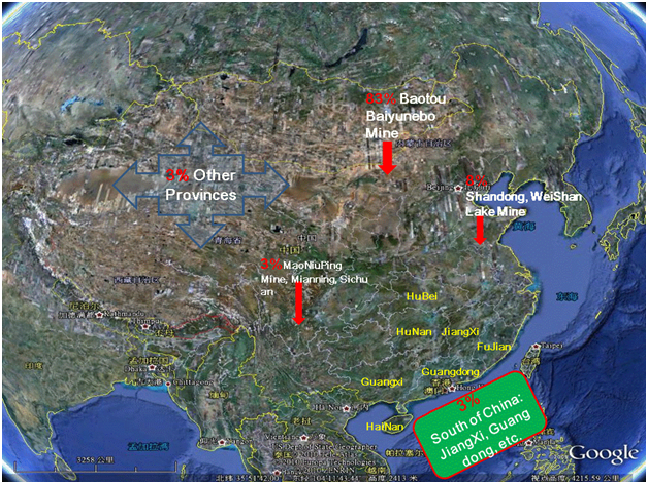
This is a distribution of the rare earth mineral deposits across China.
Consequently, countries highly dependent on rare earths, such as Germany and Japan, began to panic. An official of the Federation of Germany Industry anonymously noted that with regards to rare earths, “China runs a virtual monopoly. There is a real need to develop new sources". German Chancellor Angela Merkel responded by stating that it was “urgently necessary” to step up European investment in regions such as Eastern Europe or Central Asia in order to break the reliance on China. Furthermore, Germany agreed to convene a special conference in early November 2010 with members of the WTO and European Commission to discuss the issue. Yoshikatsu Nakayama, Japanese vice-minister of the economy, trade, and industry warned that Japan’s cache of rare earth minerals could vanish by March or April unless China reverses its export ban. Japan is deeply concerned about the situation, due to the heavy reliance on rare earths for a wide array of its export products, ranging from hybrid cars to LCD screens.
China is able to wield such influence because it is the dominant supplier of rare earths to the world market. According to the Government Accountability Office, China produced roughly 120,000 tons of rare earths in 2009, or 97 percent, of the world’s supply. Deng Xiaoping’s 1992 statement that, “there is oil in the Middle East; but there is rare earth in China” has been realized by the Chinese. For certain minerals, such as dysprosium and terbium, China produces over 99% of the world’s supply. These minerals are utilized in nuclear reactors, fluorescent lamps, and hybrid cars, among other applications.
 To understand China’s strategy in this regard, it is necessary to look at the distribution of rare earth deposits around the world. Estimates suggest that China possesses anywhere from 36 to 50 percent of the global reserves. While this figure is high, significant deposits of rare earth minerals are obviously located outside of China. The largest rare earth concentration is actually in Greenland at the Kvanefjeld Mines, which accounts for 36 percent of the world’s supply. The next largest deposit is at the Bayan Obo mines in Inner Mongolia, in northern China. While roughly 32 percent of the world’s deposits are located here, Bayan Obo produces approximately 45 percent of the global supply. After these two major locations, concentrations drop off significantly. Some rare earth deposits lie scattered across Australia, and 7 percent of the world’s supply lies in the Mountain Pass Mines in California near the Nevada border.
 Deposits outside of China, however, are rarely worked. As the 2010 U.S. Geological Survey of Mineral Commodity Summaries indicates, while 120,000 tons of rare earth production came from China, only 2,700 tons came from India, and only 650 tons from Brazil. No production was recorded from the United States or Australia in 2009. Surprisingly, Greenland with its Kvanefjeld Mines was absent from the list as well. The government of Denmark, which controlled all oil, gas and mineral resources in Greenland until early 2010, has opposed all resource extraction that involves radioactive materials which are usually found in association with rare earth minerals. As a general rule, environmental hazards have formed a barrier for rare earth mining. Ore materials are usually embedded with radioactive elements, such as thorium, radium, or uranium. In order to isolate the rare earth minerals from the radioactive material, the ore must be intensively processed in acid baths generating large quantities of toxic waste. In the case of California’s Mountain Pass mines, extraction was suspended in 1998 after thousands of gallons of radioactive waste spilled into the neighboring land. For much of the world, stringent environmental regulations make rare earth mining economically impractical. In China, with its lax environmental standards, such conditions do not exist, creating an excellent setting from which to extract rare earth minerals with little concern for regulations.

An image of the Mountain Pass Mine in California.
While China has been the predominant supplier of rare earth minerals for some time, it is currently seeking to reduce exports for several reasons. While some claim this decision is a "21st century economic weapon" and a case of monopolistic bullying, China argues that it is simply trying to conserve these non-renewable resources. China may also be trying to increase the market value of its exports. One government official explicitly stated that China “wants a higher price on our rare earth minerals [so that] foreign buyers more or less share our costs, including the high cost of reducing environmental pollution".
The resulting rare earth shortages have begun to catch attention of governments across the world. As a result, new production sites are being explored in areas such as the United States, Australia, Canada, and Greenland. The Government Accountability Office, however, estimates that it may take up to fifteen years before the U.S. can rebuild its supply chain. Significant costs to entering the market may preclude private investors from making a real impact unless government subsidies are forthcoming. But with the increasing need for rare earth minerals in both green technologies (wind turbines, electric and hybrid cars) and defense industries (anti-missile systems, jet engines, or missile guidance systems), this issue has serious national security implications as well. As a result, a number of countries may soon begin to invest heavily in rare earth extraction.